
Please Note: Clicking on an image will take you to a higher resolution version of the image you clicked on.
2025-05-09: It all started with an Amishman walking into the shop... he wanted to get a VFD to run a 3-phase motor on single phase... normally not a big deal - you size the drive appropriately and give them a walkthrough on the drive. Thankfully, I didn't have much interaction up until the point that a Hobart 4346 Meat Mixer/Grinder got unloaded. And then I got ...the rest of the story...
He hooked up the drive and was attempting to use it to power the whole machine (not just a motor), kinda like a phase converter. And that wasn't working too good because he wanted to run the motor slower than 60Hz - somewhere around 50Hz. (The contactors didn't like the frequency, nor did they appreciate the lower voltage from the 240 to 120VAC step down transformer inside the control panel being powered by this newly out-of-spec power source.) Seems they got this machine at an auction and paid to get it mechanically rebuilt before realizing that it was a 3-phase unit. Oh boy! Now it is my problem to get working!

Image of the nameplate; in the interest of not having this haunt me in the future, part of the serial number is pixelated.
Now I seem to have forgotten to take a couple images. Probably because of the smell and gunk I got to experience after removing a couple covers. (I had to do some cleaning up of dried 'juices' and gunk.) I did however discover at least 6 different screw types being used on one particular cover (that should have had only one). I also saw that all but one of them was not stainless steel. Upon opening the electrical panel, I happened to notice many pulled out wires and disconnected parts. (They had removed the thermal sensor wires from the motor and the box heater had a large black smoke trail up the back of the box). There seemed to be an empty place for an unknown module and a brand new step-down transformer. I confess I wasted a long time trying to find a wiring diagram on the machine and online... (So for anyone else - here you go!) If only I had checked the back of the covers I had previously removed!

Ahh! This missing module is labeled 'MPB' on this diagram. and PIB is missing too. and IFB as well. That might explain the smoke from the 30-Watt electrical box heater. And the 60Hz Transformer has been replaced with a 240VAC->120VAC transformer. Oh, and the 120VAC Pilot light is blown. Thermistor wires are all electrical taped in a bundle in the box. Could be worse. Could be better.


Front panel inward facing side. Looks nice and simple. Replays are wired to work as a holding latch which is released by the stop switch.

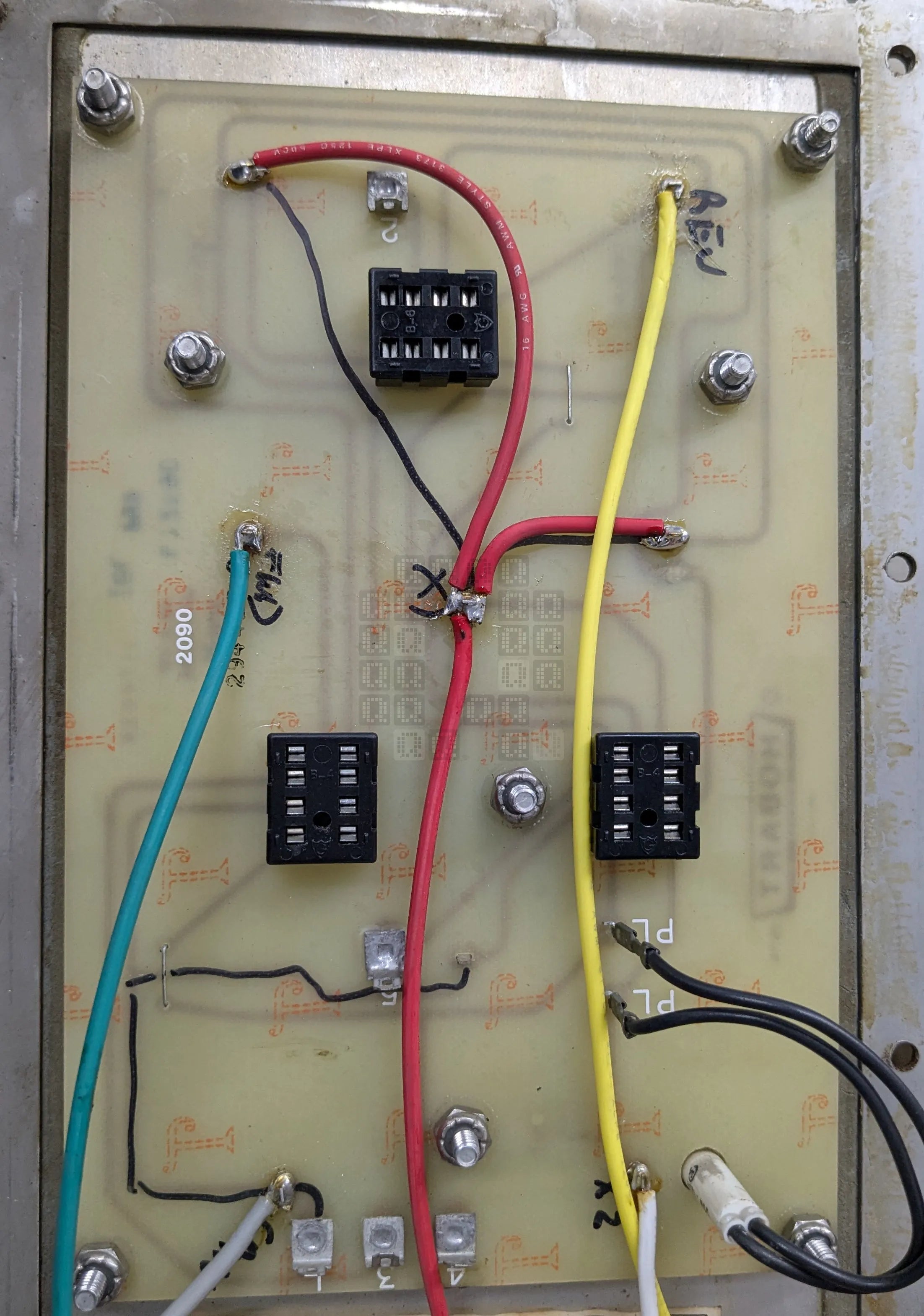
Front side of the circuit board. I've never seen a design like this where magnetic reed switches are used! I think that is pretty cool - no more water ingress and you can isolate your 120V control voltage from the user... except if you smash one of the switch guards through the front stainless steel panel and wedge it against the 120V circuit board traces as the previous owner had done here. (You can see my repair of the board to the immediate right of the bottom left reed switch. No wonder the transformer fuse kept popping.) But we're going to go one step better and convert the control to 24VDC and remove all the relays.

Basic Control Wiring Diagram. Fairly simple to follow. Fill in the gaps on the diagram to wire in incoming power and motor connections (including the Thermistor - double check if it is a PTC or NTC!). Mount in a suitable enclosure that provides an exit for heat and protection against liquid.
 >
>

ok, I may not have gotten this wired right the first time... or the second time... But I did get it wired correctly the third time! First time I didn't connect the output from the normally closed stop switch to the run switches. (added two red wires). The second time was the fact that I wired the foot switch activator and foot switch to be enabled all the time (CMN->Switches->Run/Jog); I do need to have a stop switch in there to interrupt the signal. Use only the right most image for reference. The other two will not work safely (or at all!)

Front of VFD showing wire locations on headers. I don't have the relay connected to the indicator light, nor do I have the PLC to relay wire installed. I also didn't have the thermistor connected at this point. (NTC vs PTC... seems someone rewound the motor and put new ones in.)
I also didn't take any pretty images of the finished machine. Probably better that way - it grew a giant sealed control box wart that looked ugly. Anyway, I'll leave this project here... It wasn't a very pretty result, but it works and it is a lot safer of a setup than the one that existed on the machine before it was handed to me. This solution also eliminated a lot of electrical parts (contactors & transformers) and brought low voltage (24VDC) to the control switches (instead of 120VAC). Feel free to tell me how I should have repaired it instead. There's always a couple good solutions/suggestions that I wouldn't have thought of on my own!
As always, use the information contained in this page at your own risk. Your machine may be wired differently and you should really be a qualified electrician to work on equipment like this - you probably won't be able to copy the wiring shown here and have it work. I've left quite a few plot holes in this page for a reason. Reminder: Danger! High Voltage; Danger! Do not under any circumstances disable any machine safety circuits!