
Please Note: Clicking on an image will take you to a higher resolution version of the image you clicked on.
2024-10-12: A couple months back, I was cleaning out a small part of my garage... This typically results in interesting re-discoveries and this was no exception. I found a box filled with black project boxes. I had picked up the contents of this box in a larger lot full of cables and other assorted items at a local auction. The day of reckoning for this box has arrived; It is now time to discover what they are and then to decide what to do with them.
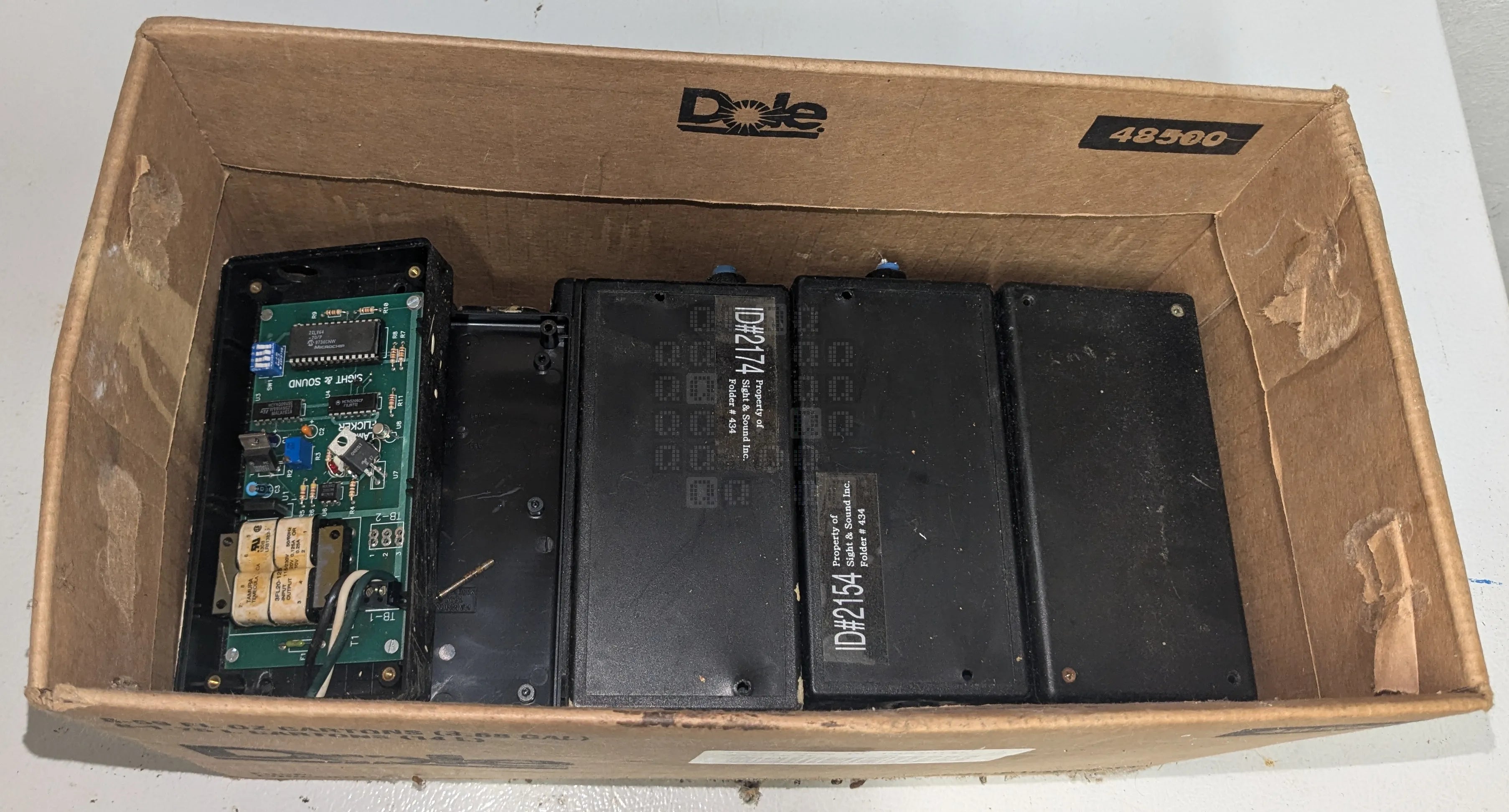

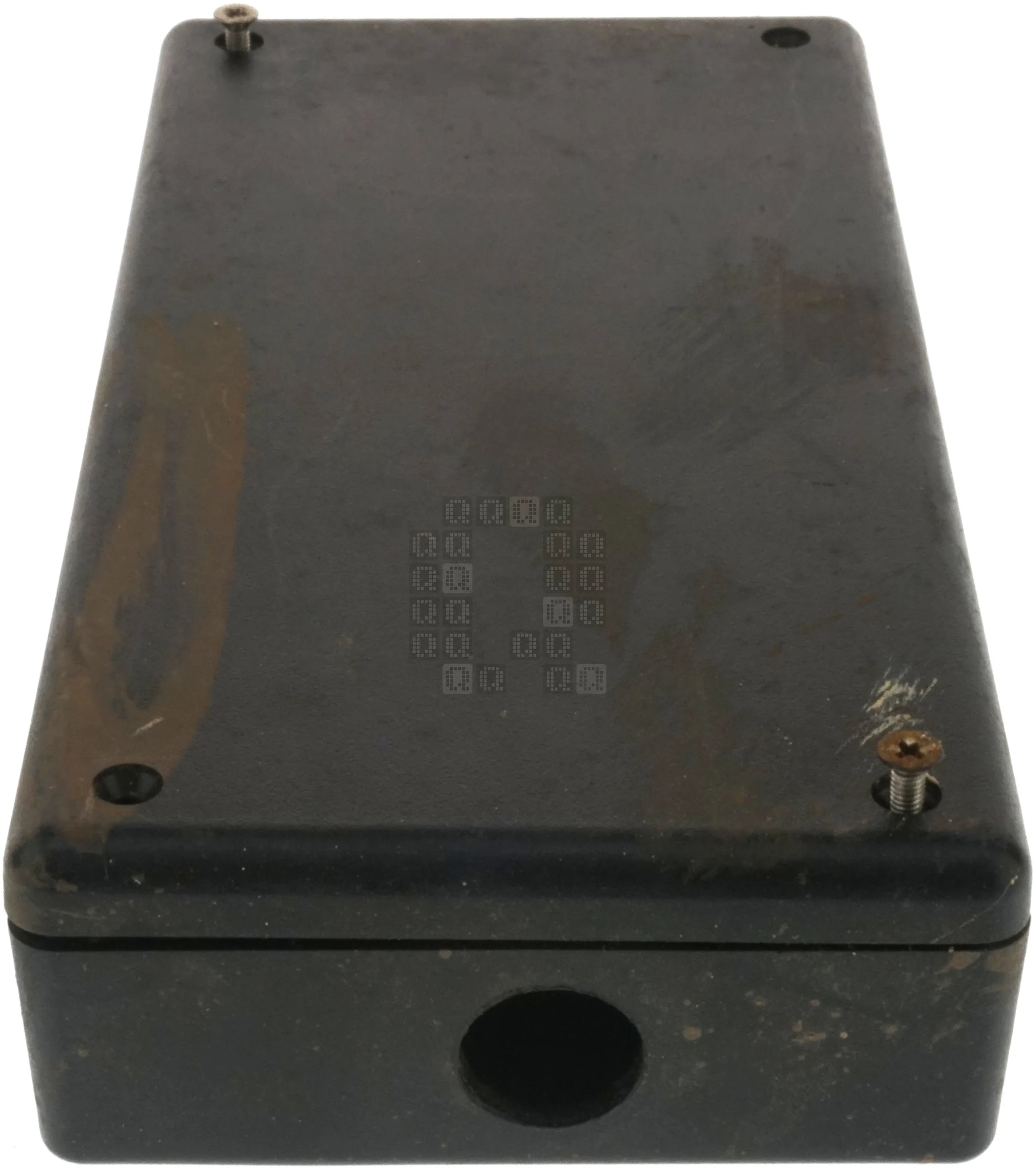
This is the outside of the box. 6.75" x 3.375" x 1.375" outside dimensions. Black in color; all have various shades of brown paint on the outside. 5/8" hole on each end, which had a cord clamp with a chopped off cord in it. Every box has exactly 2 screws.

And this is the inside of the box. I know of a local company called 'Sight and Sound'; I also know that they produce a production called 'Noah'.Their name also shows up on a label on the back of the box with an ID number. Hmm... now I'm a little curious.
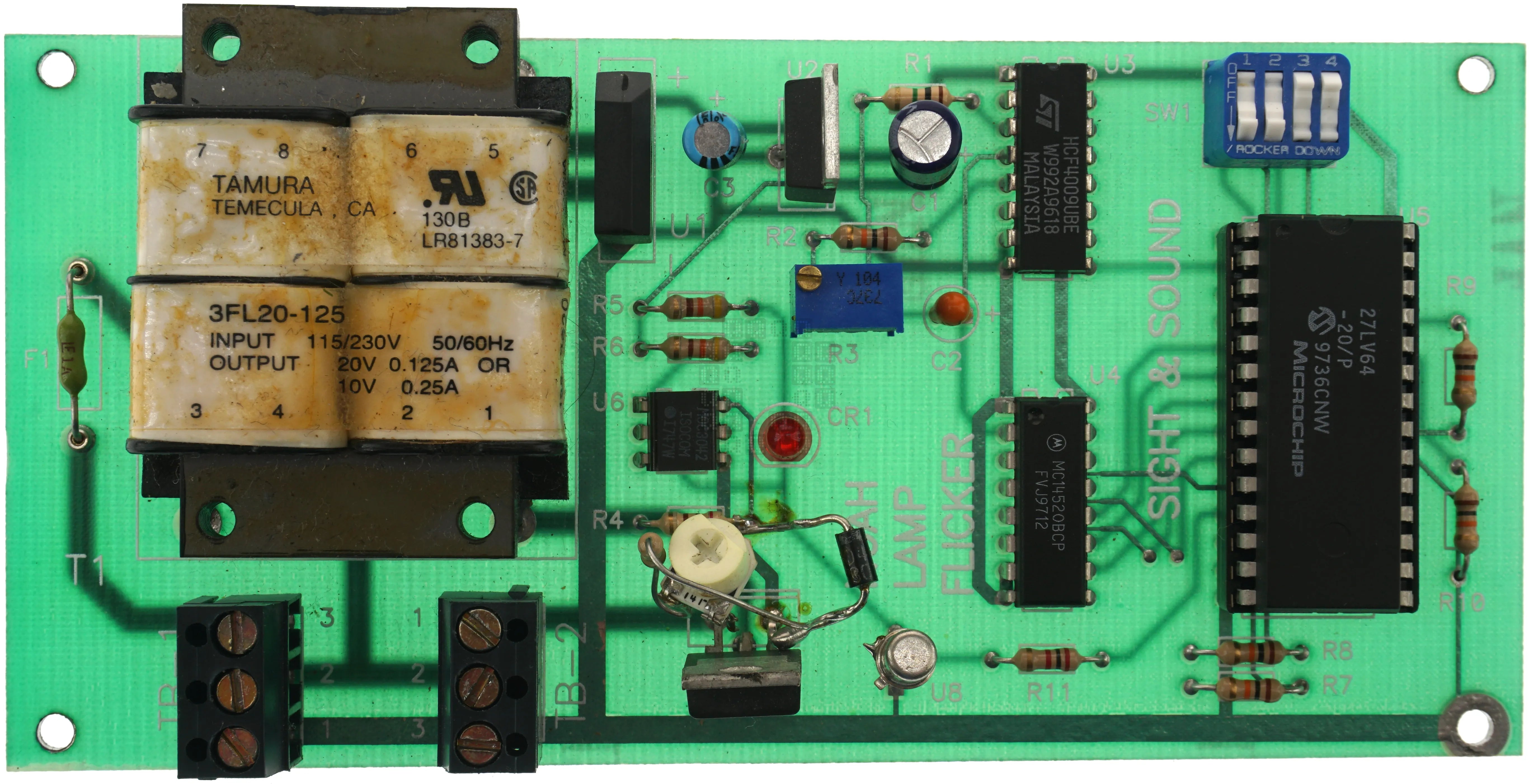
Top of the circuit board... There isn't a whole lot here. Bottom left is the input connector (TB-1) and output connector (TB-2). Left is a transformer, Tamura 3FL20-125 (Datasheet, PDF, 330KB).. Middle top is the rectifier, capacitors & 7805 5VDC regulator. U3 is a a ST HCF4009UBE Hex Buffer (Datasheet, PDF, 140KB). U4 is a Motorola MC14520BCP Dual Up Counter (Similar Datasheet, PDF, 182KB). And U5 is a Microchip 27LV64-20/P 64K CMOS EPROM (Datasheet, PDF, 133KB). And if you are vaguely familiar with IC's right now, you are probably wondering the same thing I was... Where is the CPU? (see image below for the back of the board)

The back of the board is pretty bare. Double-sided board; no components on the back. Labeled '70139 WA 10-97'. Would the 97 be the year it was designed? (Sight and Sound website says Noah debuted in 1995, so it would be about right.)
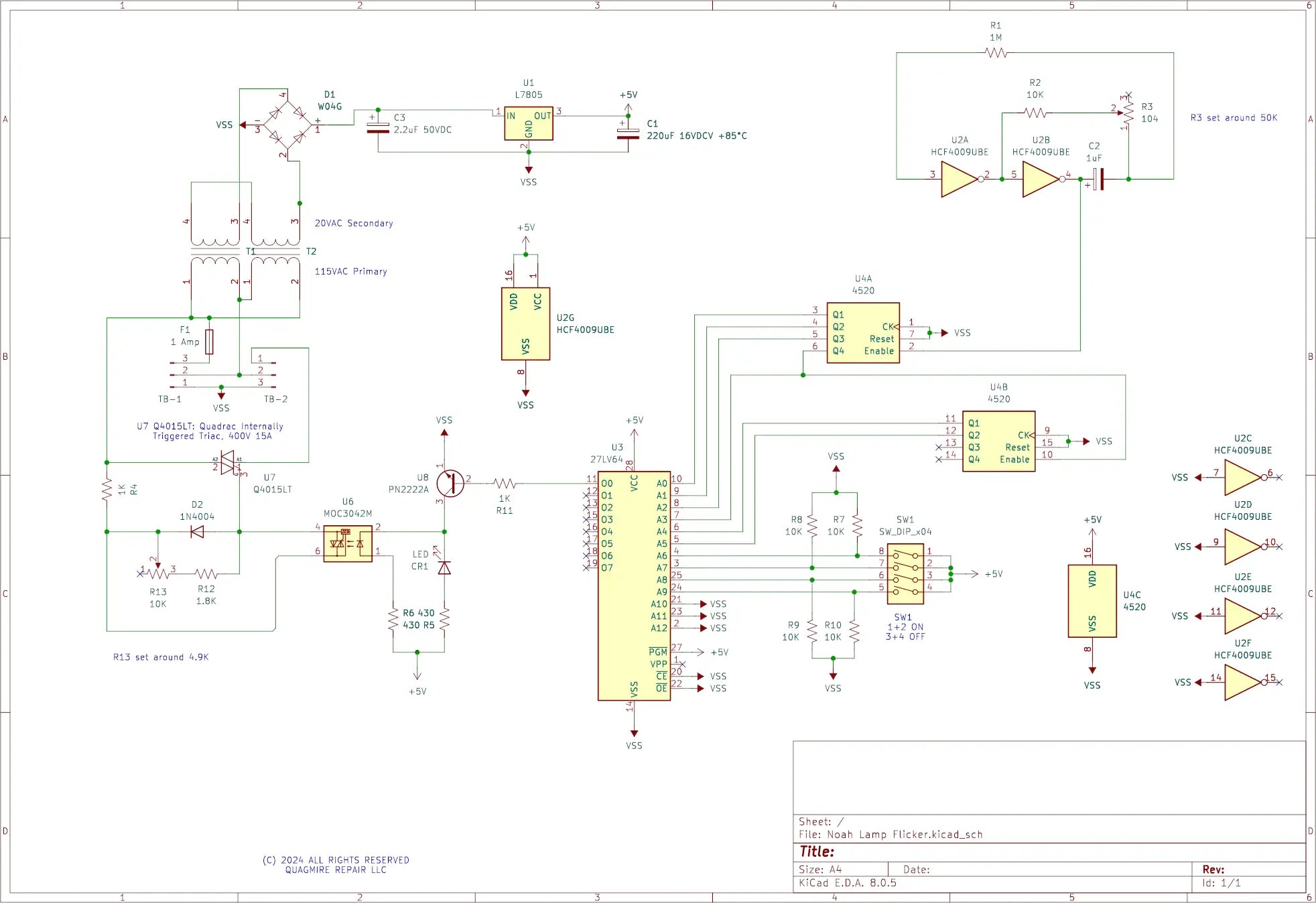
At this point I had to diagram this circuit. The ROM just made the circuit seem very odd. So lets look at the diagram quickly: Upper left is input voltage and 5VDC regulation. Upper right is two 4009 hex inverters wired to produce a clock signal. This feeds into two stages of the 14520 counter IC. The outputs of the counter are sent into the first 6 ROM address inputs. 4 additional switches (SW1) control the next 4 address bits for the ROM. The rest of the inputs are grounded. Exactly one output (O0) is sent to a transistor (U8) which then feeds into the LED and the optocoupler. The optocoupler appears to fully turn on U7, which is a Q4015LT Quadrac Internally Triggered TRIAC (Datasheet Here, PDF, 130KB). When not fully on, this triac appears to be kept partially turned on by R12/R13. This produces a bit of flash/flare effect, going from dim to bright quickly. This is definitely one of the odder circuits I have looked at in a while; there is probably a very specific reason for this setup and I would love to know more about the history of this board. Perhaps if I would buy a copy of their production on DVD I could stare at the props & backgrounds to figure out where this was used & what for. (or perhaps I have spent a little too long on this already!)

And no, I didn't forget to dump the ROM. Here it is (ZIP, 1KB). It doesn't use up much of the ROM at all.
Using the switch settings in the electrical diagram, (SW1-1 and SW1-2 on), we should start with an address of 0xC0 (Hex; Bits:1100 0000) and count to an address of 0xFF (Hex; Bits 1111 1111). 0x11 (Hex) converts to a bit pattern of 0001 0001, which means output 0 and Output 4 should be brought high. (Output 4 isn't connected to anything that I can tell.) Strangely, turning on all the switches (SW1) would result in a starting address of 0x03C0 which is all zeros.
Hopefully, you were able to learn a little about this circuit too. And if you've ever seen the Noah show and want your own module, I will be selling them on eBay!